
Today Egg Rate (Live NECC Egg Price)
(NECC Egg Price in India – Updated Today)
Today’s Rate
₹5.55
per
piece
Tray Price
₹166.5
(30 Eggs)
Lowest Price Market
Hospet
Supermarket Rate
₹6.11
(Updated:23rd October 2026): Today NECC egg rate in India is ₹5.55 per egg, and ₹166.5 for a 30 eggs and 1 peti egg price today is ₹1166 crate price (210 eggs).
Wholesale egg rate and NECC suggested price are both ₹5.55 today, while supermarket rates are slightly higher at ₹6.11. The egg crate price (tray of 30 eggs) is at ₹166.5.
Hospet has the lowest price today at ₹5.55, and Kolkata (WB) shows the highest rate of ₹6.60. These rates are updated daily using available market reference data. Actual local selling prices may vary.
Let’s check the latest national egg rates today in India cities…
Today Egg Price NECC Live Updates – 23rd October 2026
| Market | Piece | Tray | 100 Pcs | Peti |
|---|---|---|---|---|
| Ahmedabad | ₹6.05 | ₹181.50 | ₹605 | ₹1,271 |
| Ajmer | ₹5.93 | ₹177.90 | ₹593 | ₹1,245 |
| Barwala | ₹5.97 | ₹179.10 | ₹597 | ₹1,254 |
| Bengaluru (CC) | ₹6.15 | ₹184.50 | ₹615 | ₹1,292 |
| Brahmapur (OD) | ₹6.25 | ₹187.50 | ₹625 | ₹1,313 |
| Chennai (CC) | ₹6.40 | ₹192.00 | ₹640 | ₹1,344 |
| Chittoor | ₹6.33 | ₹189.90 | ₹633 | ₹1,329 |
| Delhi (CC) | ₹6.30 | ₹189.00 | ₹630 | ₹1,323 |
| E.Godavari | ₹5.90 | ₹177.00 | ₹590 | ₹1,239 |
| Hospet | ₹5.55 | ₹166.50 | ₹555 | ₹1,166 |
| Hyderabad | ₹5.65 | ₹169.50 | ₹565 | ₹1,187 |
| Jabalpur | ₹5.95 | ₹178.50 | ₹595 | ₹1,250 |
| Kolkata (WB) | ₹6.60 | ₹198.00 | ₹660 | ₹1,386 |
| Ludhiana | ₹6.00 | ₹180.00 | ₹600 | ₹1,260 |
| Mumbai (CC) | ₹6.20 | ₹186.00 | ₹620 | ₹1,302 |
| Mysuru | ₹6.35 | ₹190.50 | ₹635 | ₹1,334 |
| Namakkal | ₹5.70 | ₹171.00 | ₹570 | ₹1,197 |
| Pune | ₹6.15 | ₹184.50 | ₹615 | ₹1,292 |
| Raipur | ₹5.85 | ₹175.50 | ₹585 | ₹1,229 |
| Surat | ₹6.15 | ₹184.50 | ₹615 | ₹1,292 |
| Vijayawada | ₹6.15 | ₹184.50 | ₹615 | ₹1,292 |
| Vizag | ₹5.90 | ₹177.00 | ₹590 | ₹1,239 |
| W.Godavari | ₹5.90 | ₹177.00 | ₹590 | ₹1,239 |
| Warangal | ₹5.67 | ₹170.10 | ₹567 | ₹1,191 |
| Allahabad (CC) | ₹6.38 | ₹191.40 | ₹638 | ₹1,340 |
| Bhopal | ₹5.90 | ₹177.00 | ₹590 | ₹1,239 |
| Indore (CC) | ₹5.90 | ₹177.00 | ₹590 | ₹1,239 |
| Kanpur (CC) | ₹6.33 | ₹189.90 | ₹633 | ₹1,329 |
| Luknow (CC) | ₹6.40 | ₹192.00 | ₹640 | ₹1,344 |
| Muzaffurpur (CC) | ₹6.55 | ₹196.50 | ₹655 | ₹1,376 |
| Nagpur | ₹6.15 | ₹184.50 | ₹615 | ₹1,292 |
| Patna | ₹6.55 | ₹196.50 | ₹655 | ₹1,376 |
| Ranchi (CC) | ₹6.33 | ₹189.90 | ₹633 | ₹1,329 |
| Varanasi (CC) | ₹6.33 | ₹189.90 | ₹633 | ₹1,329 |
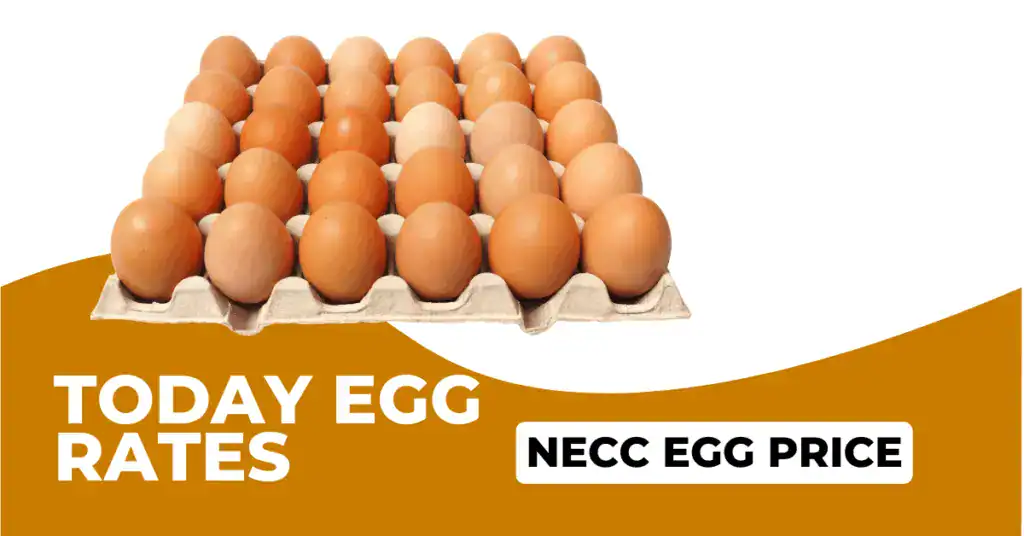
Understanding today’s egg rate
There is no single egg price in India. Today’s board runs from ₹5.55 in Hospet to ₹6.60 in Kolkata (WB), and a spread of that size is normal rather than unusual. Understanding where it comes from tells you more than the headline number does.
The producing belts set the price
Almost all of India’s eggs come from a handful of clusters. Barwala in Haryana, currently at ₹5.97, supplies Delhi, Punjab and most of the northern corridor. Namakkal in Tamil Nadu, at ₹5.70, is the single largest egg-producing district in the country and feeds Chennai, Bengaluru and Kerala. Ajmer covers the west, while the Godavari districts of Andhra Pradesh supply the east.
Everywhere else buys from these belts. When a belt moves, the cities it supplies follow within a day or two. That is why watching Barwala and Namakkal tells you where the rest of the board is heading.
Distance explains most of the gap
Delhi sits at ₹6.30, close to Barwala and cheap to supply. Mumbai sits at ₹6.20, with no poultry belt within easy reach, so every egg arrives carrying a long haul and a breakage allowance.
That difference is structural. It is not that one market has better eggs or sharper traders. It is that one is standing next to the farm and the other is not. Freight and breakage account for most of the national spread on any given day.
Consumption patterns add the rest. Kolkata at ₹6.60 serves a state that eats far more eggs than it produces, so West Bengal depends on incoming supply from Andhra and reacts sharply when those belts tighten. Hyderabad at ₹5.65 sits close to production and stays steadier.
What the rate on this page actually is
The figures here are wholesale reference prices, meaning what a trader pays at the mandi buying by the peti of 210 eggs. They are not what you will pay in a shop.
A tray of 30 costs ₹166.5 at the wholesale rate. In a kirana the same tray usually costs ₹30 to ₹45 more, because the shop is carrying freight from the mandi, breakage of two to four percent, and its own margin. Supermarkets add more again for grading, cartoning and shelf space.
If you are buying for a household, treat the number on this page as a floor. If you are buying for a shop, hotel or canteen, it is the number you should be negotiating against.
National Egg Market Rate
MARKET | PIECE |
|---|---|
NECC Egg Rate Today | ₹5.55 |
Wholesale Egg Rate | ₹5.55 |
Retail Egg Rate | ₹6.22 |
Supermarket Rate | ₹6.11 |
Lowest Rate: Hospet | ₹5.55 |
Highest Rate: Kolkata (WB) | ₹6.60 |
Egg Price Comparison by City
Top 20- Kolkata (WB) ₹6.60
- Muzaffurpur (CC) ₹6.55
- Patna ₹6.55
- Chennai (CC) ₹6.40
- Luknow (CC) ₹6.40
- Allahabad (CC) ₹6.38
- Mysuru ₹6.35
- Chittoor ₹6.33
- Kanpur (CC) ₹6.33
- Ranchi (CC) ₹6.33
- Varanasi (CC) ₹6.33
- Delhi (CC) ₹6.30
- Brahmapur (OD) ₹6.25
- Mumbai (CC) ₹6.20
- Bengaluru (CC) ₹6.15
- Pune ₹6.15
- Surat ₹6.15
- Vijayawada ₹6.15
- Nagpur ₹6.15
- Ahmedabad ₹6.05
NECC-National Egg Coordination Committee (NECC)
The National Egg Coordination Committee (NECC) is an organization formed by poultry farmers and industry stakeholders to bring more transparency and coordination to India’s egg market. It was established in May 1982 with the involvement of Dr. B.V. Rao, a notable figure in the growth of India’s poultry industry. Dr. Rao was recognized by the World Poultry Science Association and received the Padma Shri from the Government of India in 1990 for his contribution to the sector.
NECC gathers market information from farmers, traders, and zonal representatives to publish a suggested daily reference rate for the egg trade. TodayEggRateIndia.com is an independent, informational website and is not officially affiliated with NECC, any government department, or poultry authority. We share these reference rates for general awareness only, and actual local prices can differ.

Six things that decide today’s egg rate
Feed cost sets the floor
Maize and soya meal make up the bulk of what it costs to keep a layer bird producing. When maize moves at the mandi, egg rates follow, but not immediately. Farmers absorb the first shock and pass it on once margins compress, so feed-driven moves take weeks to appear and are slow to reverse. This is also why egg prices rarely fall far during a poor maize harvest, whatever demand happens to be doing.
Distance from the producing belt
India’s eggs come overwhelmingly from a handful of clusters. Namakkal in Tamil Nadu, the Godavari districts of Andhra Pradesh, Barwala and Hisar in Haryana, and Ajmer in Rajasthan supply most of the country. Everywhere else buys from those belts, and the further a city sits from its supplier, the more freight and breakage load onto the price. This is the main reason today’s board spreads from ₹5.55 to ₹6.60. It is not that one market has better eggs. It is that one is standing next to the farm.
Season and temperature
Layer birds produce less in extreme heat and eat more in extreme cold, so the cost per egg rises at both ends of the year. Only winter brings rising demand alongside it. Eggs are widely eaten as warming food from October onwards, which is why rates climb through winter, peak around December and January, then ease from February. Summer is the mirror image. Demand falls because eggs are considered heating, and stock gets pushed to market rather than held, making it the weakest stretch of the year.
The religious calendar
Demand drops sharply during Navratri, Shravan and similar periods when large numbers of households avoid non-vegetarian food, then recovers just as sharply afterwards. The effect is strongly regional. A Shravan slump hits Maharashtra and Gujarat far harder than West Bengal or Kerala. This is one of the few price movements in the market that can be predicted months in advance.
Disease and supply shocks
Avian influenza outbreaks cut supply and frighten demand at the same time, so the net effect is genuinely unpredictable. Prices sometimes fall on consumer caution even as production drops. Reporting matters as much as the outbreak itself, and a headline in a major market can move rates faster than the disease does.
Institutional demand
Mid-day meal schemes, anganwadi programmes, hostels, bakeries and the confectionery trade absorb enormous volume. School holidays and exam seasons show up in the board. This is one of the least visible but most reliable drivers of short-term movement.
Your Guide to Daily Wholesale Egg Rates
“Sunday ho ya Monday, Roj Khao Ande!”
Wholesale egg rates are the prices at which distributors and traders buy and sell eggs in bulk, before they reach retail shops or supermarkets. These rates change often, and many buyers and sellers use the daily reference rate published by NECC as a general guide rather than a fixed price.
As eggs move from the wholesale market to retailers and supermarkets, costs such as transport, handling, and retail margin get added. That’s why supermarket and retail prices are usually a bit higher than the wholesale rate.
Egg prices can shift from day to day due to demand and supply, weather, and feed costs, among other factors. Checking the daily rate here can help you follow general price movement, but we recommend confirming the exact price with your local shop or market before buying or selling in bulk.
Egg Consumption in India
Egg consumption in India has grown steadily over the past decade, as more households include eggs as an affordable source of protein in their daily diet. Government data has pointed to a clear rise in per-person egg availability compared to a decade ago, reflecting changing food habits nationwide.
This growing demand, together with the expansion of organized poultry farming, has helped make eggs one of the most widely consumed food items in India. Exact figures can vary between different reports, but the overall trend points to steady growth in both production and consumption.

How NECC Sets Egg Prices:
NECC doesn’t directly set egg prices. Rather, it is a collaborative platform where stakeholders (poultry farmers, zonal chairman, traders, distributors, and wholesale shop owners) share real-time market data to publish Live NECC egg rate as a “suggested” rate every midnight via E2 NECC.
- Coordination, Not Regulation
NECC was founded in May 1982 to improve transparency for poultry farmers. Local chairmen compare all India and nearby zone rates before publishing a national rate list. - Market Forces & Inputs
Feed is one of the largest costs in egg production. When grain prices such as corn and soybean rise or fall, it has a direct effect on the reference rate suggested each day. - Role of Traders & Distributors
Traders and distributors negotiate directly with farmers to buy eggs in bulk. Their transport costs, storage, and current demand all play a part in shaping the final price passed down the supply chain. - Retailers & Consumer Signals
Retailers don’t primarily set egg prices, but changes in consumer behavior, cultural festivals, income changes, and dietary preferences create the market. NECC considers these factors when suggesting daily egg prices.
Poultry Industry in India
India has one of the world’s largest poultry sectors, and eggs are an important part of the country’s daily food supply. Egg production has grown over time because of rising demand, improved farming practices, and better distribution networks across cities and rural areas.
Egg prices are connected to many parts of the supply chain. Feed cost, transport, labour, farm production, local demand, weather, and seasonal consumption can all affect the final price. This is why egg rates can change from city to city and from day to day.
Large poultry farms supply many major markets, while small and medium farmers also support local availability in many regions. For consumers, traders, shopkeepers, hotels, canteens, and bulk buyers, checking daily reference rates can help understand market movement before confirming the final price locally.
Organic vs Farm Eggs
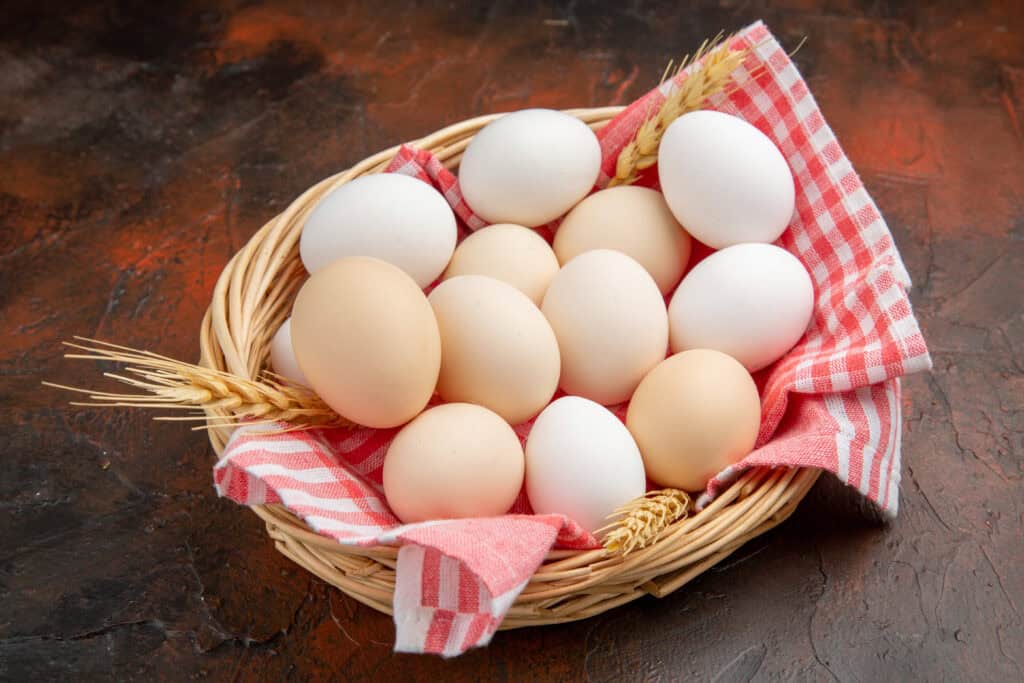
The difference between organic and farm eggs depends on how the hens are raised. Organic eggs come from hens that have organic feed and are raised with outdoor access. Farm eggs are often produced with conventional feed and come from caged hens.
Many buyers choose organic eggs because they value the farming and feeding practices involved, even though these eggs usually cost more. Others prefer regular farm eggs for their lower price and easy availability. Ultimately, the right choice depends on your budget, personal preference, and how important these farming practices are to you. If you have specific dietary or health questions, it’s best to check with a nutrition professional.
Why Egg Prices Change Daily in India
Why Egg Prices Change Daily in India If you’ve ever…
Can We Eat Eggs After the Expiry Date in India?
Can We Eat Eggs After the Expiry Date in India?…
Are Brown Eggs Better Than White Eggs?
Are Brown Eggs Better Than White Eggs? Walk into any…
How long are fresh eggs good for on the counter?
How long are fresh eggs good for on the counter?…
Can Eggs Be Kept Outside the Fridge in India?
Can Eggs Be Kept Outside the Fridge in India? In…




FAQs
What is the egg rate in India today?
The national egg rate today runs from ₹5.55 per piece in Hospet to ₹6.60 in Kolkata (WB). There is no single all-India price, NECC publishes a separate suggested rate for each declared market, and the spread between the cheapest and dearest is usually ₹1 to ₹1.50 per egg. The full market-by-market board is in the table above.
What is the NECC egg rate today?
NECC’s suggested rate today is ₹5.55 at the lowest market and ₹6.60 at the highest. NECC gathers price information from farmers, traders and zonal representatives across roughly 50 declared markets and publishes a reference figure each midnight. It is guidance, not a fixed price, actual trade happens either side of it depending on how much stock arrived and how many buyers turned up.
What is the price of 30 eggs today?
A tray of 30 eggs costs ₹166.5 at today’s wholesale rate. That is the mandi price, what a trader pays buying in bulk. In a retail shop the same tray will usually cost ₹30 to ₹45 more, because the shop carries freight, breakage of two to four percent, and its own margin. Supermarket packs work out higher again, since you are also paying for grading and cartoning.
What is the egg tray rate today?
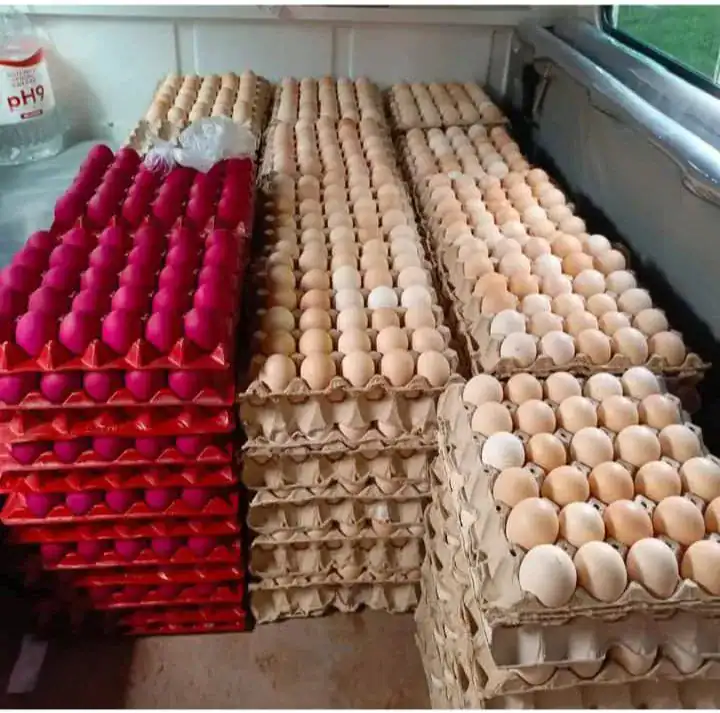
The standard tray holds 30 eggs and costs ₹166.5 wholesale today. Tray is the unit most households and small shops buy in. Larger buyers work in petis instead, which is seven trays. If you are buying a tray from a retail shop rather than a mandi, expect to pay above the figure shown here.
What is the 1 peti egg rate today?
A peti costs ₹1166 today. A peti is the standard wholesale carton in the Indian egg trade, seven trays of 30, so 210 eggs. It is the unit traders quote in, and anyone supplying a shop, hotel, canteen or bakery buys this way. Retail buyers rarely encounter it.
What is the price of 100 eggs today?
One hundred eggs cost ₹555 at today’s wholesale rate. Traders do not usually sell in hundreds — they sell in trays of 30 or petis of 210, so the hundred-egg figure is a conversion for comparison rather than a unit you can walk in and buy. For reference, 12 eggs work out to ₹67 and 24 to ₹133.20.
Which city has the lowest egg rate today?
Hospet has the lowest rate today at ₹5.55 per egg. The cheapest markets are almost always the producing belts themselves — Barwala, Ajmer, Ludhiana and Namakkal — because there is no freight between the farm and the mandi. If you buy in bulk and sit near one of these, the saving is real. If you do not, transport will usually cancel it out.
Which city has the highest egg rate today?
Kolkata (WB) is highest today at ₹6.60 per egg. The dearest markets are the ones furthest from a producing belt, with Mumbai and the southern metros usually near the top. Every kilometre between farm and market adds freight and breakage allowance to the price, which is where most of the ₹1 to ₹1.50 national spread comes from.
What is the egg rate in Barwala today?
Barwala is at ₹5.97 per egg today. Barwala is Haryana’s main layer cluster and one of the most important price-setting markets in northern India, Delhi, Punjab and much of the northern corridor take their reference from it. Because it is a producing belt rather than a consuming city, it usually sits near the bottom of the national board. See the full Barwala egg rate page for daily updates.
What is the egg rate in Namakkal today?
Namakkal is at ₹5.70 per egg today. Namakkal in Tamil Nadu is India’s single largest egg-producing district and the reference market for the entire south, Chennai, Bengaluru, Kochi and most of Kerala are supplied from here. When Namakkal moves, southern rates follow within a day or two. See the full Namakkal egg rate page.
What is the egg rate in Delhi today?
Delhi is at ₹6.30 per egg today. Delhi is supplied largely from Barwala in Haryana and Ajmer in Rajasthan, both within short freight range, which keeps it among the cheaper metro markets in the country. Delhi rates tend to track Barwala closely with a small transport premium. See the full Delhi egg rate page.
What is the egg rate in Mumbai today?
Mumbai is at ₹6.20 per egg today, consistently among the highest in the country. There is no poultry belt near Mumbai, eggs arrive from Andhra Pradesh, Haryana and interior Maharashtra, so every egg carries a long haul and a breakage allowance before it reaches the market. Pune usually trades a few paise below Mumbai for the same reason. See the full Mumbai egg rate page.
What is the egg rate in Kolkata today?
Kolkata is at ₹6.60 per egg today. West Bengal has high per-head egg consumption but produces less than it eats, so Kolkata draws heavily on Andhra Pradesh alongside local Bengal farms. That dependence on incoming supply is why Kolkata rates can move sharply when the Andhra belts tighten. See the full Kolkata egg rate page.
What is the egg rate in Hyderabad today?
Hyderabad is at ₹5.65 per egg today. Hyderabad usually sits in the lower half of the national board because it is close to the Telangana and Andhra producing belts and freight distances are short. Rates here track the Godavari district markets more closely than they track the national average. See the full Hyderabad egg rate page.
Why does my local shop charge more than the rate shown here?
The rate on this page is wholesale, what a trader pays at the mandi, buying by the peti of 210. By the time an egg reaches your kirana it has carried freight, handling, breakage loss of two to four percent, and the shopkeeper’s margin. A gap of ₹1 to ₹1.50 per egg is normal. Today’s retail reference is ₹6.22 against a wholesale rate of ₹5.55.
Do egg rates go up in winter?
Nearly every year. Demand rises because eggs are widely eaten as a warming food from October onwards, and supply gets more expensive because layer birds burn more feed keeping warm. Both forces push the same direction. The seasonal peak usually falls in December or January, easing from February.
What time is the egg rate updated?
NECC publishes its daily suggested rates around midnight. We pull and publish each morning, so the figures on this page reflect the current day’s NECC reference. On Sundays and NECC holidays, the previous working day’s rate carries forward rather than being re-estimated.
Is there an egg rate app?
We do not currently offer a mobile app, but this site works on a phone and you can add it to your home screen for one-tap access. On Android, open the browser menu and choose Add to Home screen. On iPhone, tap the share icon in Safari and choose Add to Home Screen. It will then open like an app with today’s rates already loaded.